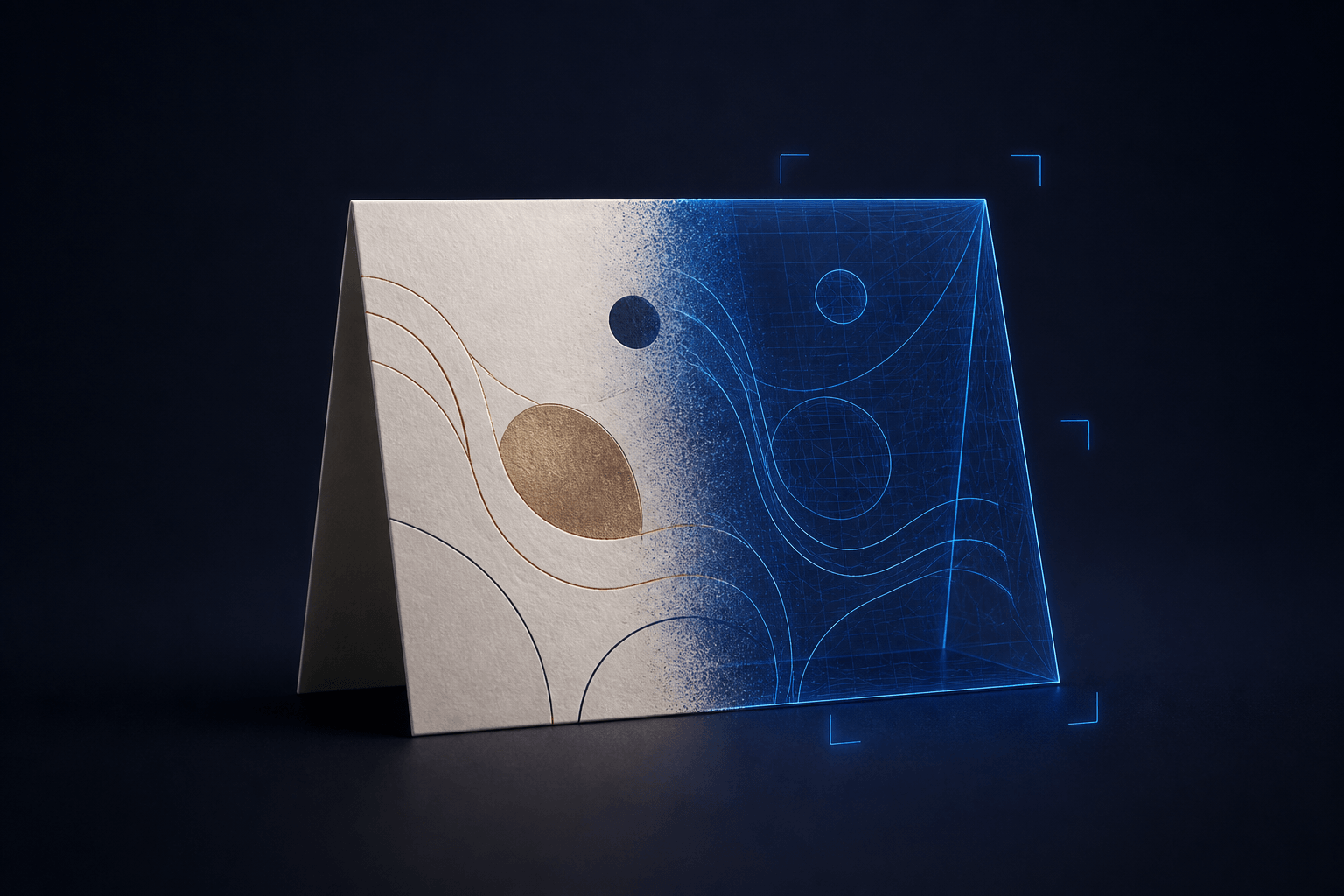
Finish & material
Finish and material visualization
Embellishments are surfaces, not colors, which is why a flat proof can only label them. ProofScene renders spot UV, foil, emboss, deboss, varnish and lamination as physical finishes on the real substrate.
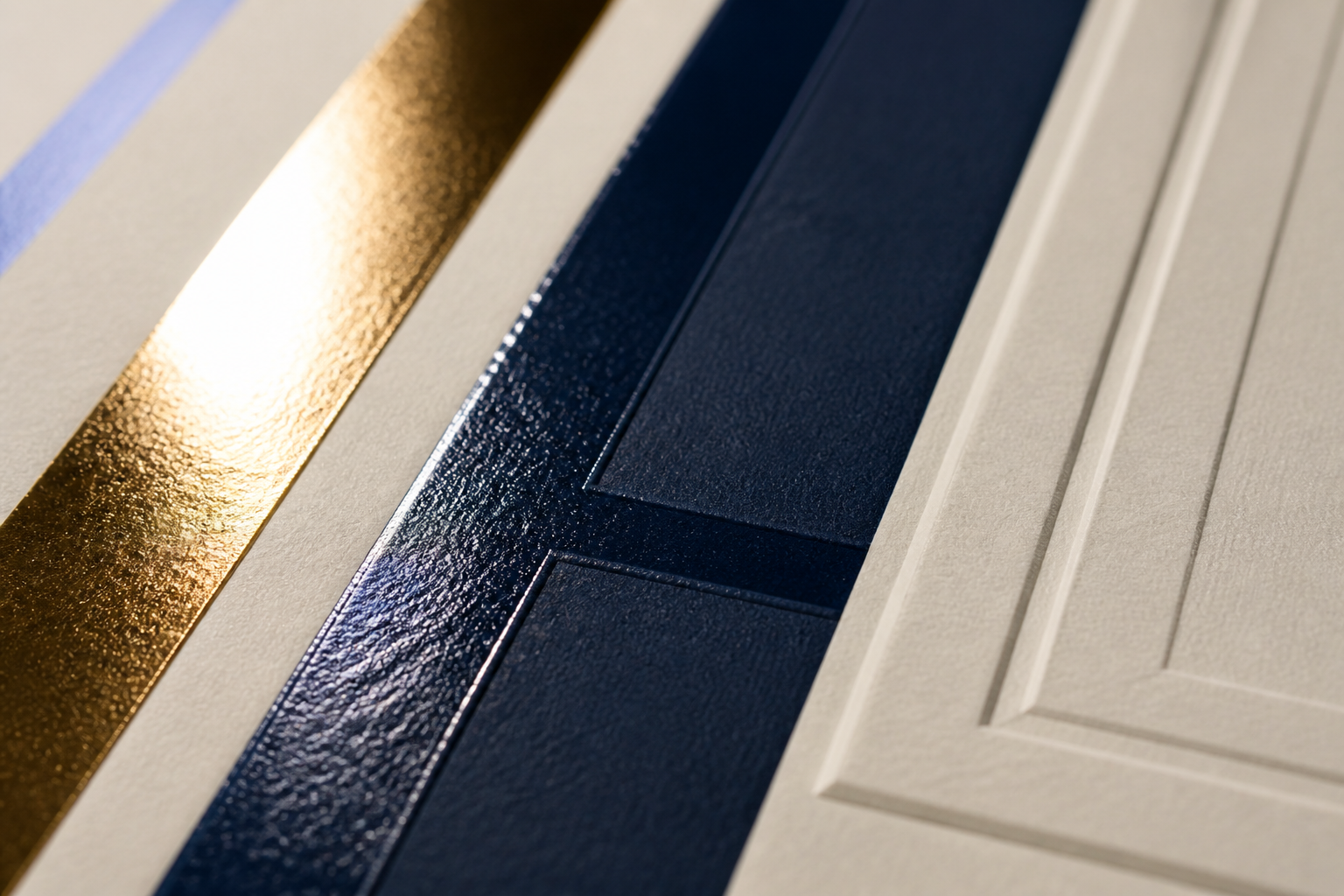
Six finishes your customer has been asked to imagine
Every one of these is sold on how it feels and how it catches the light. None of that reaches a customer through a note on a PDF.
Spot UV
A high-gloss panel sitting proud of the surface around it. Rendered as a reflective coating so the reviewer sees the contrast against matte lamination rather than a hatched box on a plan.
Foil
Metallic foil is directional: it flares as the product turns and goes dark when it does not catch a light. Coverage, position and finish (bright, brushed, holographic) all read differently in motion.
Emboss
Raised artwork with real relief, catching a highlight on one side and casting a shadow on the other. Depth is the difference between a subtle blind emboss and a heavy one.
Deboss
The inverse: artwork pressed into the substrate. On a textured board this reads very differently from an emboss, and customers frequently ask for one meaning the other.
Varnish
Gloss, matte, satin and soft-touch coatings, flood or spot. The way a varnish changes the surface is invisible on a flat proof and obvious on a 3D one.
Lamination
Matte and gloss laminate change everything above them: how ink reads, how foil sits, how a fingerprint shows. It is a material decision, not a checkbox.
The stock is half the product
Two jobs with identical artwork on different stocks are not the same job. The proof should say so.
- Uncoated stock
- Absorbent, soft, slightly muted. Artwork that sings on a coated board looks calmer here, and customers should see that before they choose it.
- Coated and gloss board
- Sharper, more saturated, more reflective. The default assumption of most artwork, and worth confirming rather than assuming.
- Textured and specialty stocks
- Laid, felt, linen and other textures interact with emboss and foil in ways that surprise people who chose the stock from a name on a list.
- Plastic and composite cards
- PVC, PET and composite card stocks with real thickness, edge behavior and surface finish, including the difference a matte card makes to a printed photograph.
- Substrate thickness
- A 250gsm carton and a 400gsm one are different products. Edge thickness is visible in 3D and invisible on a flat page.
- Films and label materials
- Clear, white and metallized label films behave differently over a container. What shows through matters as much as what prints.
Finishing is where print earns its margin and loses its arguments
Embellishment is the part of a job customers pay a premium for and understand least. A buyer who has never held a soft-touch laminate with a gloss spot UV panel has no way to evaluate the upsell, so they either decline it or accept it and hope. Both outcomes are bad: one costs you the margin, the other costs you the goodwill when the finished job does not match the picture in their head.
Showing the finish moves that decision earlier and makes it real. Customers specify more confidently when they can see what they are buying, and they complain less afterwards, because the thing that arrived is the thing they turned over on screen.
It also protects you in the other direction. If a customer asks for a heavy emboss on a stock that will not take one, that conversation is far easier to have while pointing at a model than after the die has been cut.
Related
Deeper reading on embellishment and where it matters most.
Finish and material rendering represents appearance, placement, materials and finishing. It is not a calibrated contract-color proof unless a color-managed workflow is used, and metallic foils in particular should be judged on behavior rather than on a screen color.
Finishes and materials, answered
Short, straight answers to the questions we are asked most. If yours is not here, ask.
Ask us anythingHow does ProofScene show print finishes?
Finishes are rendered as physical surface properties rather than annotations. Spot UV is a glossy raised coating, foil is a directional metallic surface, emboss has actual relief. Because the model sits in a real lighting environment, these behave as the product turns, which is how people recognize them.
Why can a flat proof not show spot UV?
Because spot UV is not a color, it is a surface. On a PDF it can only be indicated: a hatched area, a magenta overlay, a note in the margin. The customer has to translate that into an expectation, and translation is where reprints come from.
Can it show the difference between emboss and deboss?
Yes, and it is worth showing. The two are routinely confused in briefs, and seeing raised artwork next to pressed-in artwork settles the question in about two seconds, before the tooling is made.
Which substrates are supported?
Uncoated, coated and gloss boards, textured and specialty stocks, plastic and composite card materials, and label films, each with their own thickness and surface behavior. If it appears on your proof sheet as a stock choice, it should appear in the proof as a material.
Does substrate thickness really matter to a customer?
More than most shops expect. Perceived quality is heavily driven by weight and edge thickness, and it is one of the most common causes of a customer being disappointed by a job that was printed exactly to spec.
Can I compare two finishing options side by side?
Producing the same artwork as two proofs (matte laminate with spot UV against a soft-touch flood, say) is a fast way to close a specification conversation that would otherwise run for a week over email.
Is the finish rendering color accurate?
It represents appearance, placement, materials and finishing realistically, but it is not a calibrated contract-color proof unless a color-managed workflow is used. Metallic foils in particular are judged by behavior rather than by a screen color value.
Stop asking customers to imagine the foil
ProofScene is opening early access to print shops and product suppliers. Join the list and be first to turn your proof sheets into interactive 3D approvals.
No credit card · Built by print people · Launching soon