Gloss vs matte vs frosted cards: lamination finishes compared
Gloss, matte and frosted are three points on one scale: how rough the steel plate is that presses the card’s surface during lamination. A mirror-polished plate (Ra 0.01–0.04 µm) makes a gloss card, a sand-blasted plate (about 0.46–0.70 µm) a matte one, and a coarse-blasted plate (1.5–3.5 µm) a frosted one. Gloss gives the deepest colors and blacks, matte removes glare and takes a pen, and frosted adds a grain you can feel.
To compare them on your own design, load it into the free 3D credit card mockup generator and drag the finish slider from mirror gloss to frosted.
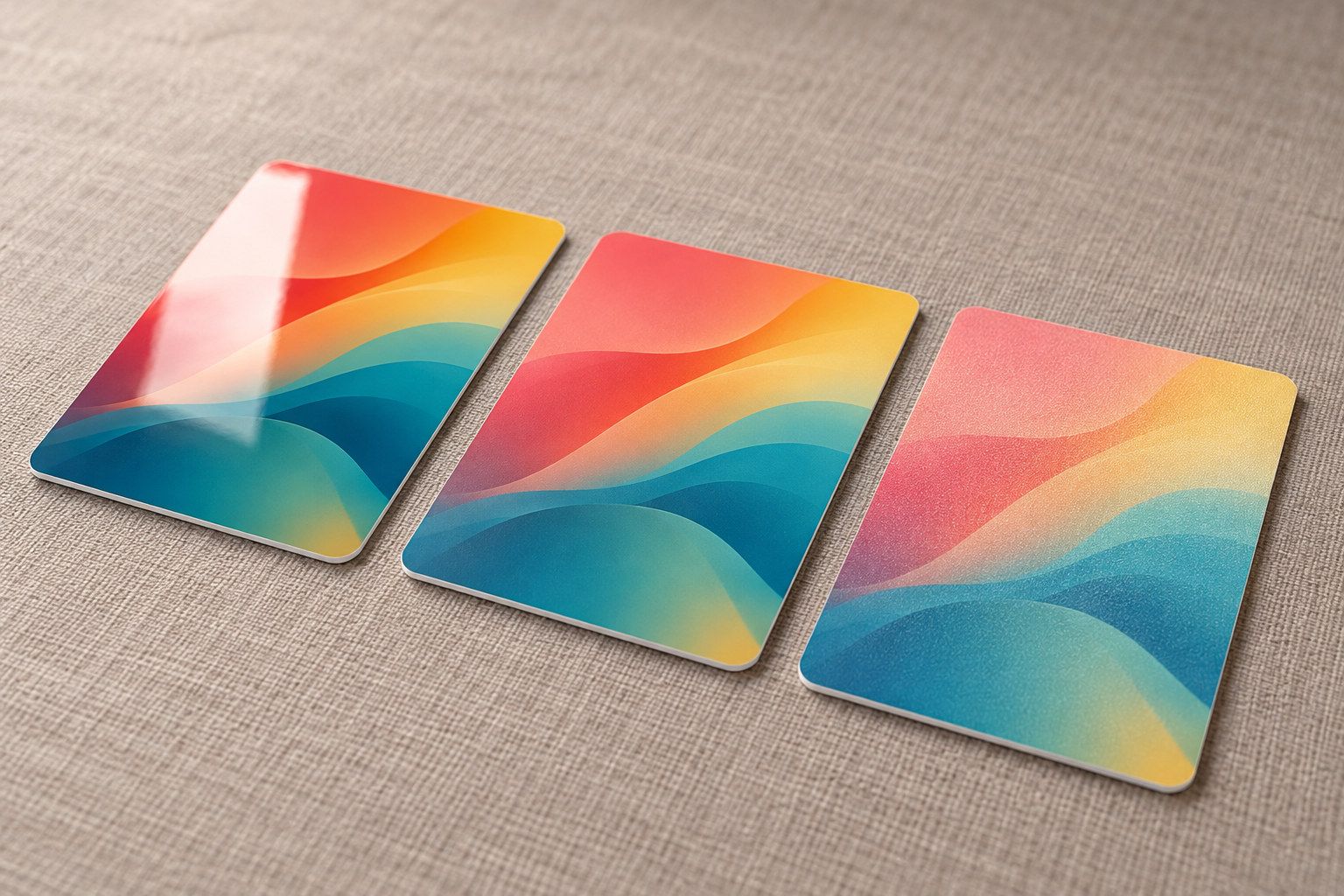
Where does a card’s finish come from?
From the press plate. During lamination, polished or sand-blasted stainless steel plates press against the card’s clear outer layers, and the softened plastic takes on the plate’s surface. The same printed sheets come out gloss, matte or frosted depending only on the plate.
The plate is copied exactly, flaws included: a scratch or speck of dust on it prints into every card, so factories use hardened plates and refinish them. One supplier rates its polished plates for about 4,000 to 6,000 press cycles. Matte film, sheet or UV coating can also give a matte look, but on most plastic cards the plate sets it.
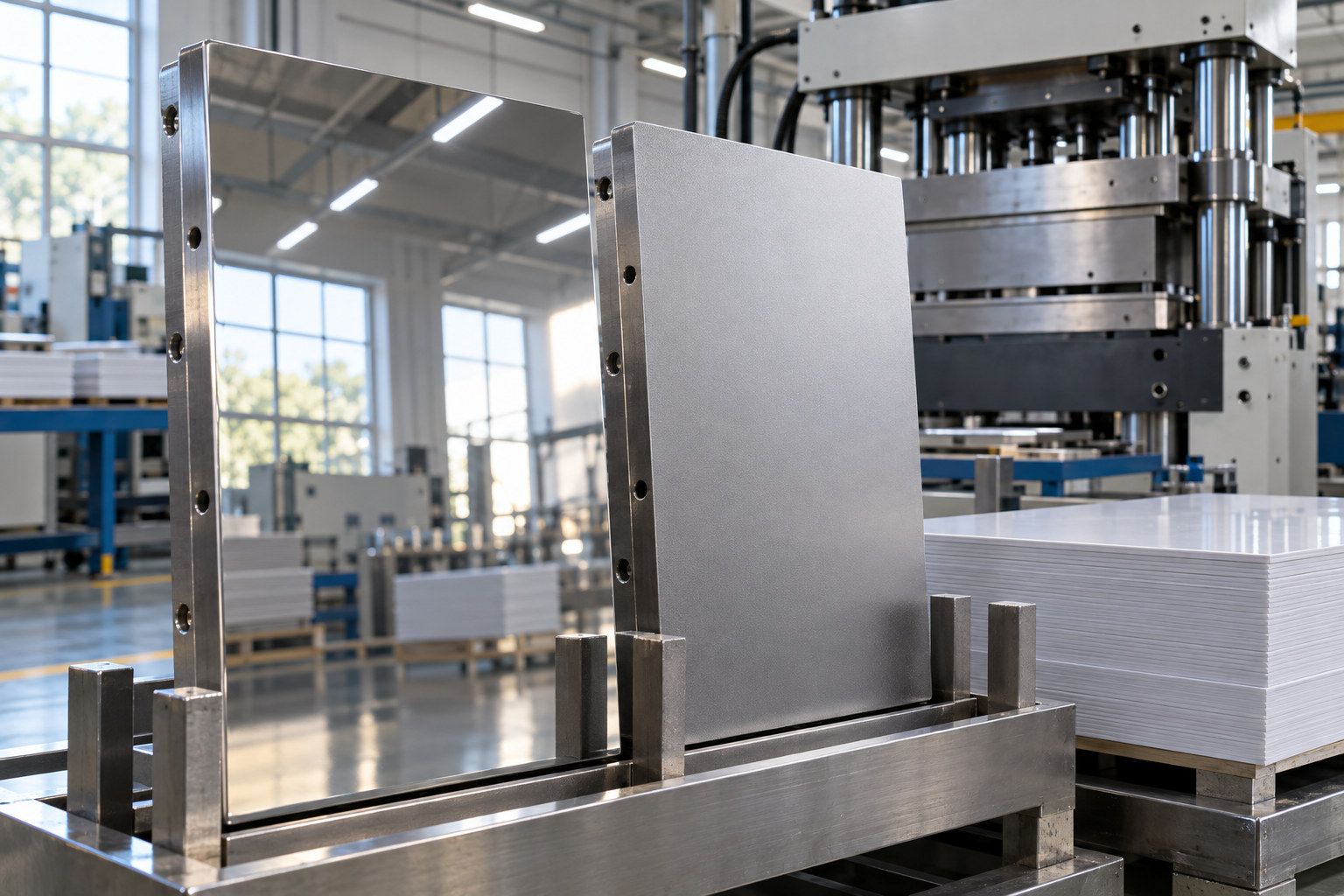
How does hot lamination work?
The card layers are pressed between the plates in a hot press, then cooled under higher pressure, in a cycle of 20 to 45 minutes. A standard 0.76 mm (30 mil) card in PVC is usually four layers: a 2 mil clear overlay, two 13 mil printed cores and another 2 mil overlay. A mil is a thousandth of an inch.
| Stage | Typical setting | What it does |
|---|---|---|
| Stack | Printed cores between clear overlays, each stack between two plates | Each plate meets one face of the card |
| Heat | Platens at 141–154 °C (285–310 °F) for 20–22 min, 125–150 psi | Fuses the layers and softens the overlay so it takes the plate’s surface; the middle sheet must reach about 132 °C (270 °F) |
| Cool | 18–22 min, rising to 250–300 psi after the first 2 min, about twice the heating pressure | Sets the surface while it is still pressed against the plate |
| Unload | At 38 °C (100 °F) or below | Opening the press while hotter warps the cards |
Settings from Klockner Pentaplast card-film specialists in ICMA’s Card Manufacturing magazine (2011), reprinted by Tekra; psi is the press’s hydraulic ram pressure, not the pressure on the sheet. Single-sheet presses can cycle in 45 to 90 seconds (ICMA, 2024).
How is a card finish measured?
The plate is graded by roughness, Ra, in micrometers; the finished card can be read with a gloss meter in gloss units (GU), usually at 60°. Ra is the average height of a surface’s tiny peaks and valleys, and a micrometer (µm) is a thousandth of a millimeter.
No standard names card finishes, so each plate maker uses its own names or codes. Schwan Lamination, for example, lists a high-gloss mirror plate, Type A, at Ra 0.02 to 0.04 µm, and seven matte types from Type M at 0.18 to 0.26 µm to Type C at 1.20 to 1.35 µm. Ask factories for the plate’s Ra, not its name.
A gloss meter shines light at a fixed angle and compares the reflection with a black glass standard rated 100 GU. ISO 2813, ASTM D523 and, for plastics, ASTM D2457 measure at 60° by default, at 20° for surfaces above about 70 GU and at 85° for surfaces below about 10 GU. A flawless PVC surface reads only about 96 GU at 60°, so an opaque PVC card cannot read much higher. A plate supplier quoting 500 or 800 GU is measuring polished steel, not your card.
What are the nine finishes, from mirror gloss to frosted?
The nine steps run from mirror gloss at Ra 0.01–0.04 µm and about 88–96 GU to frosted at Ra 1.5–3.5 µm and about 1–6 GU. Most Ra bands follow plate makers’ published ladders; high gloss and semi-gloss are interpolated, and frosted runs past the roughest published plate (3.0 µm).
The gloss column is an estimate, not a standard: no plate or card maker publishes the gloss of the finished card for each plate, so the ranges come from published roughness and gloss data on plastics. For your order, ask the factory to read its sample cards with a 60° gloss meter.
| # | Finish | Plate Ra (µm) | Estimated gloss (GU at 60°) | Look and feel | Often used for |
|---|---|---|---|---|---|
| 1 | Mirror gloss | 0.01–0.04 | 88–96 | Glass-smooth and wet-looking, like a piano finish | Photo, bank and premium cards |
| 2 | High gloss | 0.05–0.08 | 75–90 | The classic shiny credit card | Gift, loyalty and membership cards |
| 3 | Semi-gloss | 0.09–0.14 | 45–70 | Still shiny, with softer reflections | Hard-wearing cards that stay shiny |
| 4 | Satin (silk) | 0.15–0.26 | 25–50 | A soft, silky sheen | Bank and stripe cards |
| 5 | Semi-matte | 0.27–0.45 | 15–35 | Low sheen, easy to read under any light | Membership, VIP and hotel cards |
| 6 | Matte | 0.46–0.70 | 9–22 | Velvety, no glare | Premium and dark-colored designs |
| 7 | Coarse matte | 0.70–0.95 | 7–14 | Flat and dry to the touch | Textured brand cards |
| 8 | Heavy matte | 1.0–1.5 | 3–10 | Chalky, the flattest matte | Rugged, tactile cards |
| 9 | Frosted | 1.5–3.5 | 1–6 | A visible grain, like frosted glass | Clear cards and hotel keys |
Mirror gloss
High gloss
Semi-gloss
Satin (silk)
Semi-matte
Matte
Coarse matte
Heavy matte
Frosted
Why do dark designs look deeper on gloss than on matte?
Because every plastic surface reflects about 4% of the light that hits it, and the finish decides where that light goes. Gloss sends it in one direction, so you see it as a sharp reflection at one angle and black stays black everywhere else. Matte spreads the same light across the whole card as a faint veil, which lifts black toward charcoal.
In a worked example, Datacolor calculated that the same black plastic looks about 13 ΔE lighter with a matte surface than with a gloss one, and about 3 ΔE lighter with semi-gloss (light at 45°, viewer straight on), and says the figures agree very well with what observers see. ΔE measures color difference; 13 is obvious at a glance.
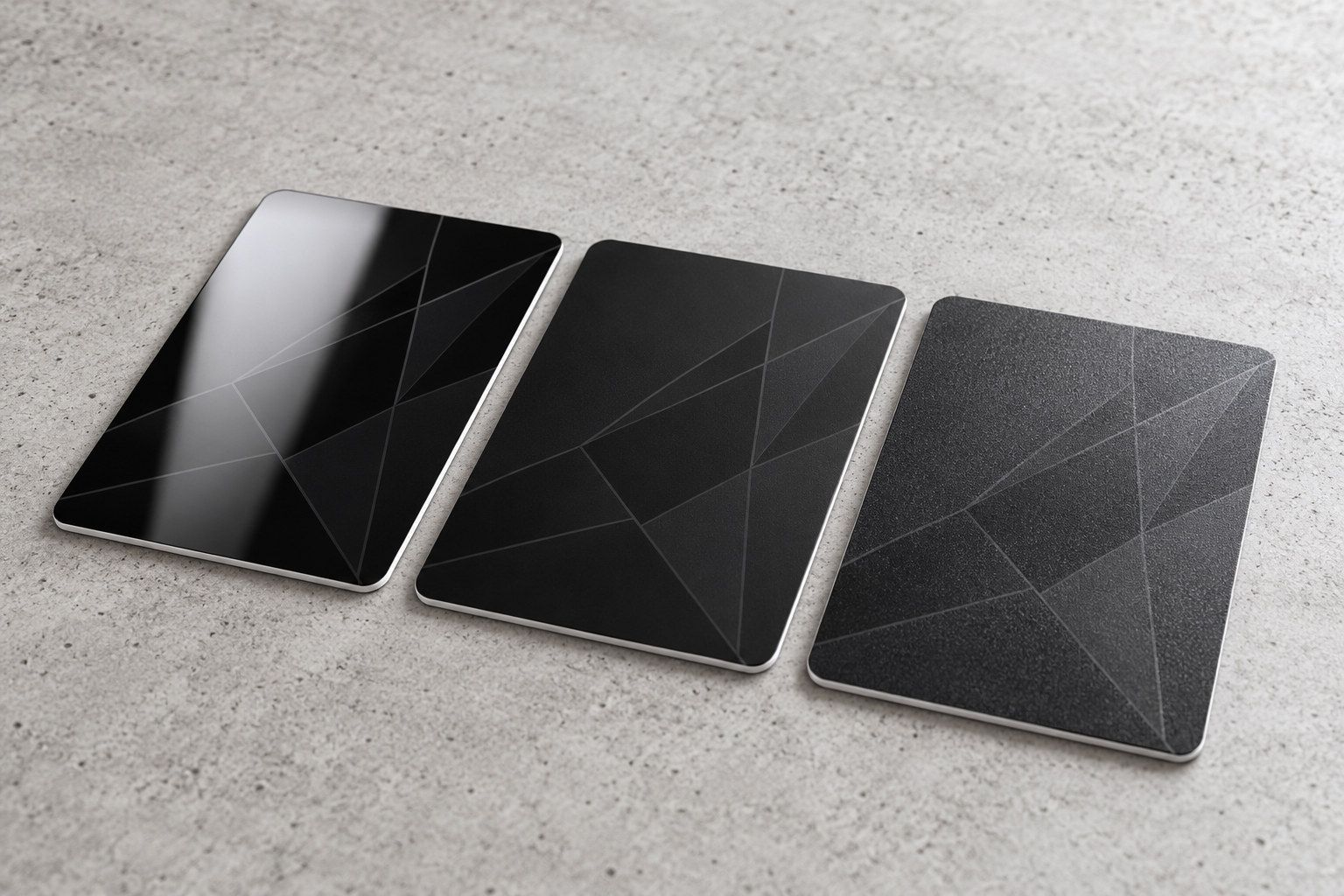
Judge finishes under one bright light with a darker surround, the way a buyer sees a card at a counter. Under soft, even light from every side, gloss and matte look almost the same. Tilt any card toward a grazing angle and it shines, because a PVC surface reflects about 4.5% of light face-on but about 62% at 85°. See also why PVC and RFID cards never match your design.
Which finish shows fingerprints and scratches?
The evidence is mixed. Card makers say fine matte and frosted textures hide small marks and call frosted scratch-resistant, while a book printer reports that gloss lamination shows prints and scratches least. No controlled test on plastic cards has been published. On gloss, a fingerprint can smear the mirror and a hairline scratch can catch the light; on matte and frosted, the texture scatters light around small marks.
Skin oil can fill a matte texture and leave a darker, shinier patch, most visible on dark matte, and hard rubbing can polish shiny streaks into it. On clear frosted cards a wet fingerprint even shows as a clear spot: Rhopoint measured a roughened clear acrylic film that scattered 56% of the light passing through it, and only 1.5% once wetted with a matching oil. Handle samples before you choose.
Can you write or print on matte and frosted cards?
Matte is the best finish to write on; coarse matte and frosted can be hard to print on afterward. Card suppliers such as CardSource recommend matte for cards people sign or write on, such as event passes and reward cards.
Desktop card printers are pickier. A direct-to-card printer presses its printhead onto the card, so a coarse surface can show through the print, while a retransfer printer prints onto a film first and is less affected. One plate supplier states that cards from its coarse and medium frost plates cannot take flat-printed numbers. Smoother finishes print best: Cardel describes its silk plate as receptive to holograms, thermal printing and dye-sublimation printing.
What is spot gloss on a matte card?
Spot gloss, usually called spot UV, is a clear varnish printed only where you want shine and cured with ultraviolet light, so a logo or pattern gleams against a matte card; built up thick, it feels slightly raised. A factory can also use a plate with gloss and matte zones: one patented plate sets glossy diamonds of about Ra 0.02 µm into a background of about 0.5 µm that the patent calls silk.
Showing spot UV, foil, emboss and varnish digitally covers how to present these effects to a customer. Soft-touch, a velvety rubber-like feel, comes from a coating or film rather than a plate; the glossary defines it.
Which finish should you choose for each type of card?
Payment cards commonly use gloss or satin, matte is a common choice for premium and membership cards, and frosted suits clear and tactile cards.
| Card | Usual choice | Why | Watch for |
|---|---|---|---|
| Payment (credit, debit) | Gloss or satin | Silk plates take printing and holograms well | Keep the stripe area smooth |
| Hotel key | Semi-matte or matte; frosted on keys without a stripe | Logos read under lobby lights | On stripe keys, ask for a smooth stripe zone (Ra 0.40 µm or less) |
| Gift and loyalty | High gloss; matte if people write on them | Gloss keeps photos and colors brightest | Scratches can show on gloss |
| ID badge | Gloss or satin | Prints cleanly on desktop card printers | Coarse textures show through direct-to-card printing |
| Membership and VIP | Semi-matte or matte | Low glare, premium feel, takes a signature | Dark designs read lighter |
| Luxury and black cards | Gloss for the deepest black, or matte with spot gloss | Matte looks velvety; spot gloss lifts the logo | Matte black reads charcoal; oily prints can show |
| Clear and translucent cards | Frosted | The grain turns clear PVC translucent | Water and fingerprints leave clear spots |
On a stripe card, check the finish against the smoothness limit in magnetic stripe dimensions; for hotel programs, see the hotel key card artwork approval checklist.
How can you see each finish before you order?
Render the design in all nine finishes first, then confirm with printed samples. The free 3D credit card mockup generator shows your own artwork in every finish under a moving light and exports a side-by-side sheet. A screen shows how a finish behaves in light; it is not a calibrated color proof, so approve color and feel on samples from your factory.
If you produce cards for customers, ProofScene turns your production proof-sheet PDF into an interactive 3D proof, finish included, that the customer can turn over before signing off. See card and credential proofing or try it with a free account.
Is gloss or matte better for a plastic card?
Neither; they suit different cards. Gloss gives the brightest colors and deepest blacks, and suits photos, gift cards and many payment cards. Matte removes glare, feels premium and takes a pen, so it suits membership and dark designs, though blacks look noticeably lighter.
What is a frosted plastic card?
A card pressed against a coarse sand-blasted plate, about Ra 1.5–3.5 µm, or made from pre-frosted sheet, so its surface has a visible, slightly gritty grain like frosted glass. On printed cards it reads as a deep, glare-free matte. On clear PVC the grain scatters light and makes the card translucent, and a wet fingerprint shows as a clearer spot.
What is the difference between satin and matte?
Roughness and shine. A satin (silk) card comes from a plate of about Ra 0.15–0.26 µm and should read roughly 25–50 GU at 60° (an estimate): a soft sheen with blurred reflections. A matte card comes from a plate of about 0.46–0.70 µm and reads roughly 9–22 GU: no glare and a velvety feel. Satin keeps colors richer; matte takes a pen.
Do matte cards show fingerprints?
Probably less than gloss on fine matte textures, but sources disagree. Fine matte and frosted textures scatter light around small marks, while gloss can show smears and hairline scratches. Skin oil can still leave a darker, shinier patch on dark matte. No controlled test on plastic cards has been published, so handle samples first.
Is a matte card more expensive than a gloss card?
Sometimes. Some card factories charge more for matte and frosted runs, because gloss jobs can share press sheets while matte jobs often need sheets of their own, and one plate supplier’s price list puts matte plates at 1.7 to 3 times the price of mirror plates. Ask for both finishes on the same quote.