How we built Tutamen’s ICM-21 interactive 3D product page
How Proofscene turned Tutamen’s ICM-21 STEP file into a live interactive 3D product page on tutamen.com: exploded view, coolant flow and a toleranced drawing.
This case study shows how Proofscene turned the STEP file of Tutamen's ICM-21 liquid-cooling manifold into a live interactive 3D product page that buyers can turn, take apart and inspect on Tutamen's own website. Tutamen is the California-founded maker of thermal management systems and precision mechanical hardware for AI, hyperscale and network security programs, and the ICM-21 was the first of Proofscene's interactive 3D product demos built from a manufacturer's own CAD. Anyone can open it in a browser, straight from its product page.
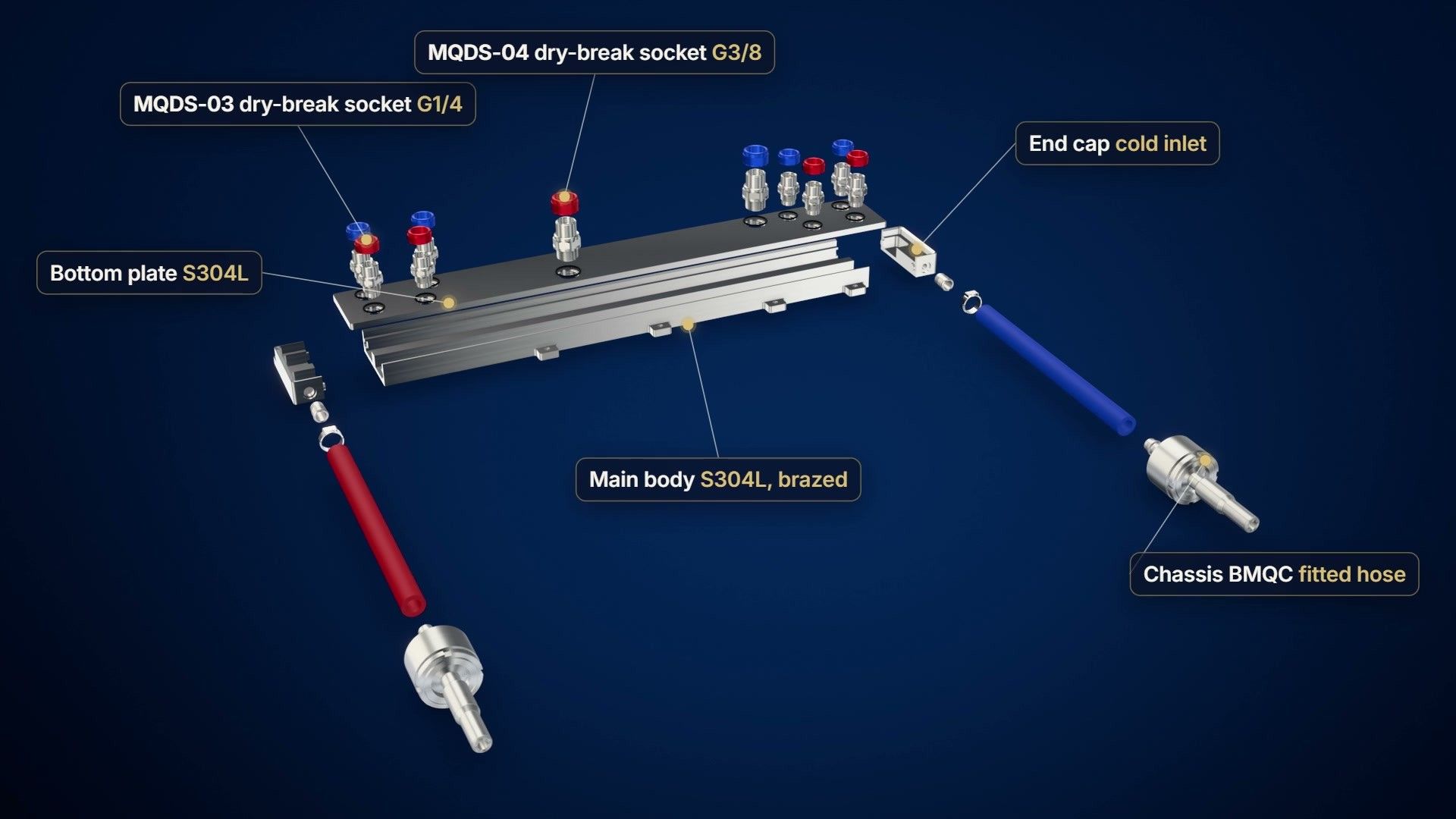
This article explains what an interactive 3D product demo is, who Tutamen is and why it was the right partner, how a demo is built from CAD, what it costs a manufacturer compared with the usual options, and which products benefit most. You can open the ICM-21 in 3D now and follow along.
What the ICM-21 demo lets a buyer do
An interactive 3D product demo is a web page where a buyer can examine a real product in three dimensions: rotate it, take it apart, cut through it, and read what every part is and what it is made of. The service, its four live demos and how they reach a manufacturer's website are on the interactive 3D product demo page; this is what the ICM-21's does.
It fills the gap between the two things most manufacturers already publish. A product photo shows the outside from one angle. A datasheet lists dimensions, ports and materials but leaves the reader to picture how they fit together. A 3D demo puts both in one place: the product, its parts, and the numbers attached to them. In each demo a visitor can:
- turn and zoom the product, or jump to an iso, front, top or side view;
- explode the assembly, with a slider for how far it comes apart, and put it back together;
- make a section cut to see internal channels and walls, or switch to X-ray to see what sits inside a housing;
- follow the flow path through products that carry a fluid;
- tap any part for its name, material and quantity, then isolate it or hide it;
- measure the model, take a guided tour, switch between a light and a dark studio, and share the link.
Every number shown carries its source: measured from the CAD, quoted from the manufacturer's datasheet, or marked as an estimate. Nothing is invented to fill a panel.
Who is Tutamen?
Tutamen is a thermal and mechanical hardware manufacturer founded in California in 2003, whose motto is "Everything But the Board." It designs and builds the cooling and mechanical systems around the electronics in some of the most demanding computing hardware in the world, describing itself as "Engineered in America. Built at global scale."
According to its website, Tutamen has about 850 employees and more than 50 engineers, in what it calls six centers run by one engineering team: engineering and manufacturing in the United States, China, Mexico and Malaysia, and a sales office in France.
- California, USA: engineering and customer support, with a 10,000-square-foot thermal R&D and customer-testing lab being opened in Santa Clara.
- Dongguan, China: Tutamen's engineering and manufacturing headquarters, covering design, DFM, tooling, samples and production, with in-house metal stamping, CNC machining, injection molding, die-casting and a material sciences laboratory.
- Jiangxi, China: high-volume production of finished heat sinks, with dedicated anodizing and passivation, die-casting and CNC lines.
- Tijuana, Mexico: North American manufacturing since 2017, four plants totaling about 95,000 square feet in a Free Trade Zone, with USMCA-qualified "Made in Mexico" origin and FDA-registered, ISO 13485-certified medical device assembly.
- Penang, Malaysia: Tutamen's newest plant and first in Southeast Asia, a Free Trade Zone face-plate and final-assembly line.
- France: European sales and support.
The company holds ISO 9001:2015, ISO 13485:2016 and ISO 14001:2015 certification, and its site lists customer awards including three consecutive Palo Alto Networks awards from 2023 to 2025, back-to-back quality awards from Foxconn in 2024 and 2025, and a 2025 NPI launch award from the medical technology company Enovis.
Tutamen's product range runs from passive and air-cooled heat sinks through vapor chambers, heat pipes and liquid cold plates to manifold and plumbing systems, chassis, rails and rack structures, and its own ThermoChem materials line. Its site frames the moment it is building for as "the AI heat curve", citing Nvidia's roadmap of 600 kW per rack by 2027 and a megawatt by 2028.
What is the ICM-21, and why show it in 3D?
The ICM-21 is an intra-chassis liquid-cooling manifold for a 21-inch, 2U liquid-cooled server tray. It sits between the chassis quick disconnects and the cold plates, and splits the coolant across five hard-wired branches: one pair feeds the ASIC and VRM cold plates, and four pairs feed the OSFP modules. The split is fixed by the manifold's internal geometry rather than by valves, so there is nothing to set or drift in the field. The published specifications:
| Specification | ICM-21 |
|---|---|
| Body | CNC-machined, brazed S304L stainless steel |
| Branches | 5, hard-wired: ASIC + VRM about 40%, each OSFP about 15% (±5%) |
| Flow | 3 to 10 L/min; rated 7 L/min of PG25 at 40 °C inlet |
| Pressure drop | 93 kPa at 7 L/min PG25, with BMQC |
| Internal volume | 176 mL |
| Face sockets | 4 + 4 MQDS-03 on G1/4 and 1 + 1 MQDS-04 on G3/8, dry-break |
| Envelope and weight | 460.00 × 82.40 × 19.00 mm, 3.64 kg |
| Testing | 100% pressure and helium leak tested, with a serialized test record |
Almost everything that makes the ICM-21 good is invisible in a photograph. The cold and hot rows are isolated chambers with no cross-flow. Each of the ten couplings is a socket body, an anodized locking sleeve and an EPDM O-ring. The flow split lives inside a stainless body. A thermal engineer evaluating the part wants to see exactly those things, and in the 3D demo they can: explode the manifold to separate every socket, sleeve and seal, follow the coolant from the cold inlet to the hot outlet in the flow view, and read each figure without opening a PDF.
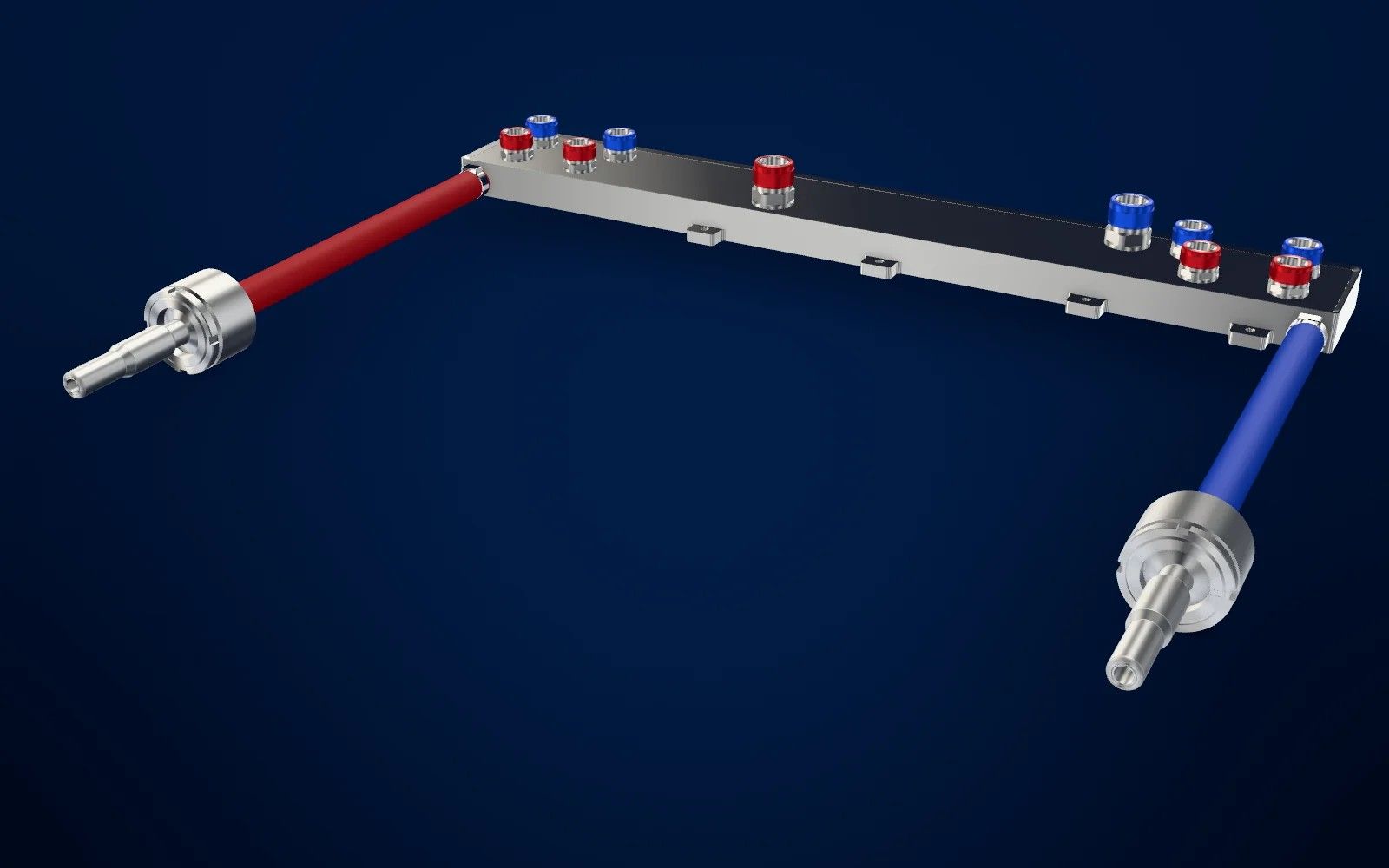
Tutamen shows the demo on its own ICM-21 product page, under its own logo, beside the datasheet. That is the point of the product: the manufacturer's buyers explore the part on the manufacturer's site.
How does Proofscene turn CAD into a 3D demo?
We start from the CAD the manufacturer already has and build a model that is faithful to it, then publish it where the manufacturer's buyers will find it. For the ICM-21, step by step:
- The manufacturer sends the STEP file and the datasheet. Tutamen supplied the ICM-21 assembly as a STEP export from its CAD system, along with the published datasheet.
- The CAD is read exactly. Each solid is meshed from its true surfaces, identical parts are recognized as one shape used many times, and volumes, areas and holes are measured from the CAD itself. The ICM-21 model has 21 kinds of part and 42 pieces in total.
- Parts are named, split and finished. Each piece gets its catalog name and its material: brazed S304L for the body, anodized finishes for the locking sleeves, EPDM for the seals. The couplings arrived as single solids, so we split each into its socket, sleeve and O-ring, re-profiling the sleeves from Tutamen's product photo inside the CAD envelope, and the viewer labels them that way.
- Every number is checked against its source. The model's calculated mass came to 3.69 kg against the datasheet's 3.64 kg. Where the CAD did not include an option, such as the leak-detection circuit, it is described in text rather than invented in 3D. Where a product photo and the CAD disagree, the model follows the CAD, and the page states that the datasheet governs.
- The demo is published at the manufacturer's address. The ICM-21 lives at tutamen.proofscene.com/icm-21 and is embedded in Tutamen's own product page with a single iframe.
- The page is ready for search. Alongside the 3D viewer, a public demo page carries a written product description, the parts by name, the specifications and structured data, so search engines and AI assistants can read what the product is without running the viewer.
The finished ICM-21 model is about 2 MB compressed and loads in any modern browser on desktop or phone, with no plugin, app or account.
What did Tutamen bring to the partnership?
Tutamen brought the ingredients that make a demo trustworthy: a real production part, a datasheet that governs, and an audience of hardware engineers who check every number. The ICM-21 shaped how the whole product line works.
Real CAD set the standard for accuracy. Building from Tutamen's production model is why every Proofscene demo treats the CAD as the source of truth and labels where each number comes from.
An engineering audience set the standard for features. An engineer evaluating a coolant manifold wants the flow split, the coupling types, the envelope and its tolerances, the materials and the test regime. The flow view, the section cut, the named parts and the sourced specification panel all exist because a part like the ICM-21 needs them.
Tutamen's own site set the standard for publishing. Every demo is built to be embedded on the manufacturer's site rather than to live on ours.
Working with a manufacturer of Tutamen's depth, with DFM, tooling, samples and production under one engineering team across North America and Asia, is the kind of partnership a new product line needs. If you build AI, data center or medical hardware and need a thermal or mechanical partner, talk to Tutamen's engineers.
Why not use a hosted 3D viewer or commission a bespoke 3D build?
A manufacturer that wants 3D on its product pages usually takes one of two routes, and each leaves gaps for an engineered product. Our guide to putting a 3D CAD model on your website compares all four routes, including building it yourself on an open web viewer.
Upload a model to a hosted 3D platform. This is quick, but it gives you a viewer rather than a product page: the model sits inside a general-purpose player, often on another company's platform and under its branding, and the named parts, materials and specifications an engineer needs are left to the datasheet.
Commission a bespoke 3D experience. This can produce exactly what you want, at a price that has kept it out of reach for most product lines. Sketchfab's own guide puts the average upfront cost of an end-to-end 3D configurator project at $15,000 to $50,000, and the configurator vendor Twikit puts the total at $10,000 to more than $100,000 depending on complexity and features. That is per project, before maintenance, and many manufacturers have dozens of products worth showing.
Proofscene's 3D demos take a third route. We build the model from the CAD you already have, publish it at your own address, and hand you one line to embed it on your site. There is no development project on your side and no new platform for your buyers to learn, and the page works for search as well as for people. Try all four live on the interactive 3D product demo page, where you can also send us your product, and see the launch films made from the same models under 3D product animation.
Which products benefit from an interactive 3D demo?
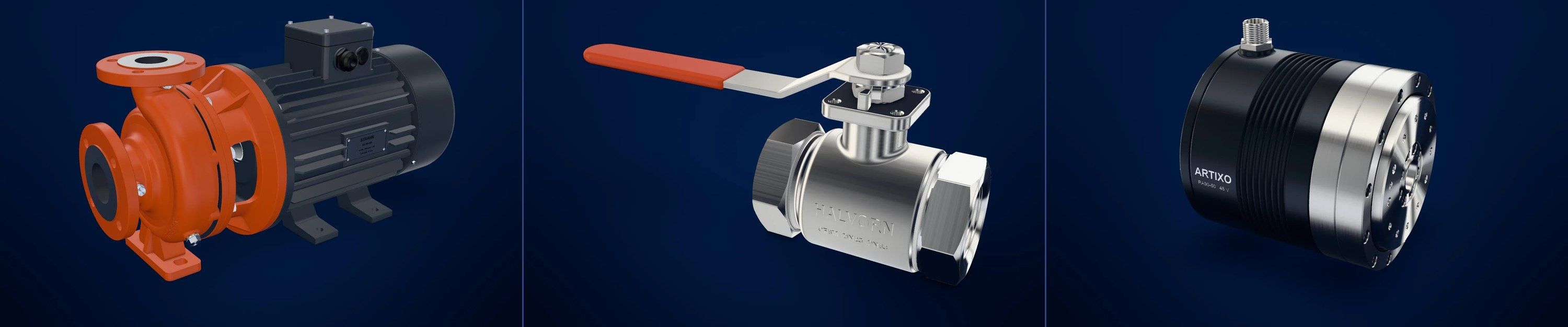
Any product whose value is inside it, or in how its parts fit together. To show the range beyond server cooling, we built three demo products from scratch in CAD, each under a fictional brand and clearly labeled as a Proofscene demo:
- STRAVIK SX 50-160, a close-coupled end-suction pump to EN 733 with a cast iron volute, a bronze impeller, a mechanical shaft seal and a 5.5 kW motor, every bearing ball included;
- HALVORN BV25, a DN25 two-piece full-bore ball valve in cast 316 stainless, with its floating ball, PTFE seats, blow-out-proof stem and packing;
- ARTIXO RA90, a 90 mm robot joint for cobots and humanoids, with a frameless motor, a 50:1 strain-wave gear, a cross-roller output bearing and an encoder in one sealed housing.
The same approach suits most complex manufactured products:
- Data center and electronics cooling: manifolds, cold plates, heat sinks and coolant distribution units, where the flow path is the product.
- Pumps, valves and fluid handling: internals that buyers otherwise only see in a cutaway drawing.
- Industrial automation and robotics: actuators, joints and gearboxes with many parts in a small envelope.
- Medical devices: assemblies whose components, materials and orientation need to be explained precisely.
- Energy storage and power equipment: enclosures whose racks, cooling loops and safety systems are hidden behind steel walls.
Energy storage shows the value clearly. A containerized battery block hides its cells, liquid-cooling loop and fire safety systems behind steel, and buyers often travel to the factory to witness acceptance tests before a unit ships; learnBESS has a clear explainer on what a factory acceptance test covers on a BESS DC block. A 3D demo lets every stakeholder understand the product long before they stand next to it at that test.
How do I get an interactive 3D demo of my product?
Send us the CAD and the datasheet, and we will tell you what the demo can show before we build it. The process is short:
- Tell us about the product through the form on the demo page: what it is, who buys it and where you want to show it.
- Share a STEP export and the datasheet. We confirm which parts, views and specifications the demo will carry.
- Review the demo. You check names, materials and numbers before anything is public.
- Publish and embed. The demo goes live at your company address, public for search or private behind a password, with one line to embed it on your own product page.
If your products are printed rather than machined, such as cards, packaging, wristbands or labels, Proofscene's core platform turns your flat proof sheets into interactive 3D print proofs you can try with a free account.
Questions about the ICM-21 project
Short answers about how the ICM-21 demo was built, what it needed and Tutamen.
Ask us anythingHow long did the ICM-21 demo take to build?
Tutamen’s STEP file arrived on 19 October 2026, and the ICM-21 demo, 42 parts with coolant flow and a toleranced drawing view, was live at tutamen.proofscene.com the same day. Larger assemblies and products that need custom motion take longer, and our team gives every new product its date before work starts.
What files does Proofscene need to build a 3D demo?
A STEP export of the assembly, which every mainstream CAD system can write, plus the product’s datasheet or product page. The CAD supplies the shape and the parts; the datasheet supplies the published numbers shown in the demo.
Can I put the 3D demo on my own website?
Yes. Each demo is published at your own address on Proofscene and, once we enable your domain, can be embedded in your product page with a single iframe, the way Tutamen shows the ICM-21 on its product page at tutamen.com.
Will search engines and AI assistants be able to read the demo page?
They can if you make the page public. A public demo page carries a written product description, the parts by name, the specifications and structured data that crawlers can read without running the 3D viewer. Demos for private sales conversations can stay out of search and behind a password instead.
Is my CAD exposed when the demo is published?
Your native CAD is not published. The page carries a display mesh made for viewing, not your CAD or STEP file, so it contains no feature history, sketches or parametric data.
Does the 3D demo work on phones?
Yes. It runs in any modern browser on desktop, tablet or phone, with no app or plugin. On a phone the panels fold into sheets so the product stays in view.
Who is Tutamen?
Tutamen is a thermal and mechanical hardware manufacturer founded in California in 2003. It designs and builds heat sinks, liquid cold plates, manifolds, chassis parts and thermal materials for AI, hyperscale and network security programs, from engineering centers in California and Dongguan and manufacturing sites in China, Mexico and Malaysia.
Related reading
Open the Tutamen ICM-21 in 3D, see how a printed product goes from proof sheet to 3D in how Proofscene works, explore the 3D proof viewer, or read how PrintPlast proofs hotel key cards in 3D.