Card carrier design: formats, card placement and artwork
A card carrier is the printed paper or board piece a card is attached to or sealed inside for mailing, retail display or hand-over, and its design starts from the dieline: the panels, folds, windows and the exact spot where the card sits. Get those right and the card lands where the artwork expects it, the window shows the right detail and the pack opens the way its copy says.
Below: the common formats, how the card is held, the artwork rules, and four carriers and a key card sleeve you can open in 3D on the Proofscene demo page, each built from the proof sheet you can download beside it. New to dielines? Start with what is a dieline?
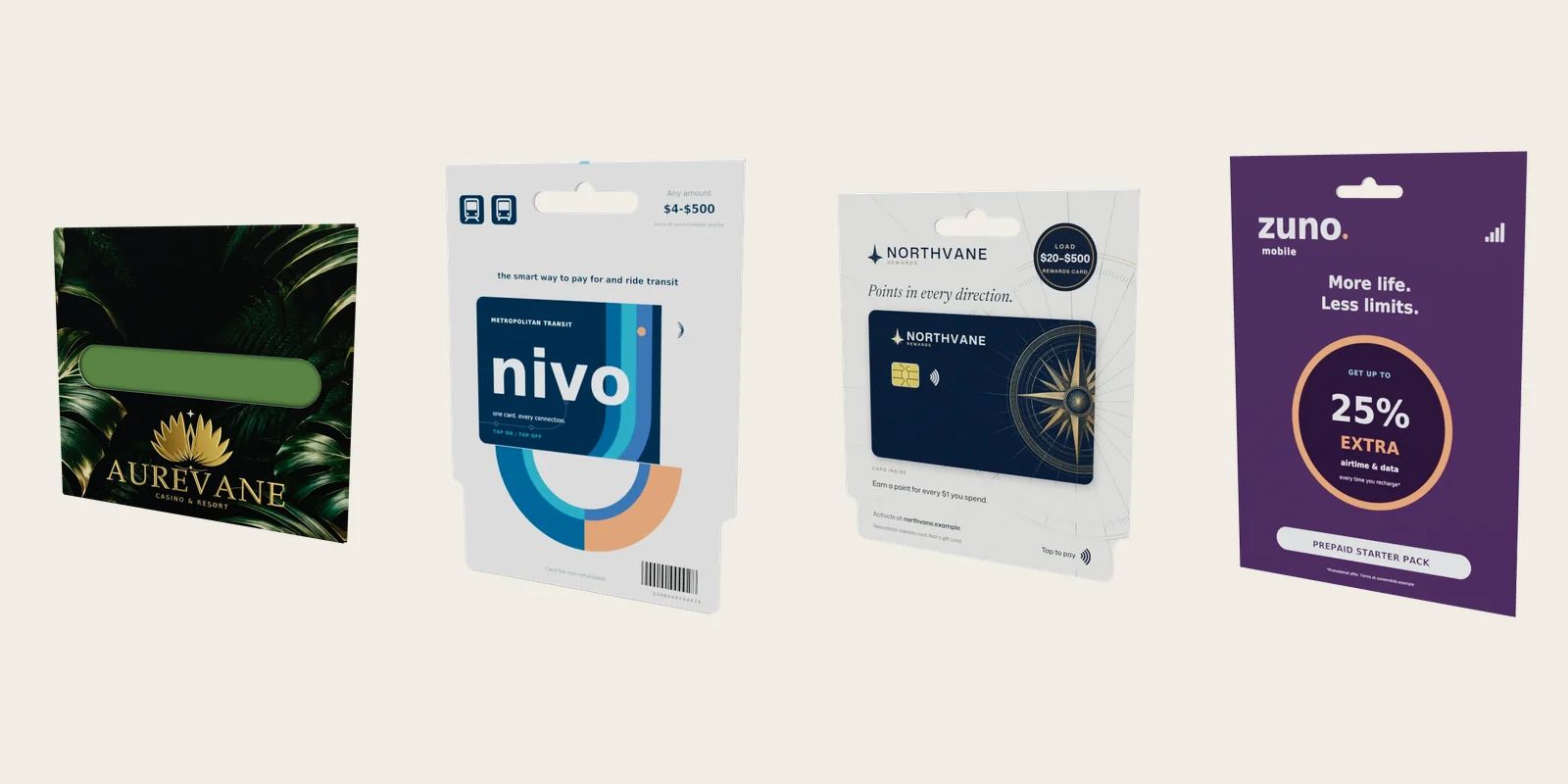
What kinds of card carriers are there?
Most card carriers are one of five formats, chosen by how the card reaches its holder: by mail, on a store hook, over a counter or at a hotel desk.
| Format | Typical cards | How the card is held | Open one in 3D |
|---|---|---|---|
| Letter carrier (card mailer) | Credit, debit and bank cards sent by mail | Removable glue on a printed letter, folded into a window envelope | Upload yours to see it in 3D |
| Folded carrier with a pocket | Casino and hotel keys, RFID chips | A pocket made by pasted flaps | Aurevane casino key carrier |
| Retail hanging pack | Gift, prepaid, rewards and transit cards | Glued inside a folded board pack with a hang slot | Nivo transit pack, Northvane rewards pack |
| SIM starter pack | SIM cards in a punch-out card | Glued behind a window, with a peel-open panel | Zuno Mobile SIM starter pack |
| Key card sleeve | Hotel key cards | A paper pocket with a thumb notch | Ventoro key sleeve and card |
Two more folded pieces on the demo page use techniques carriers borrow: the Folia petal wallet, whose four die-cut petals fold over one another, and the Lanternway DL welcome envelope with its peel-and-seal flap.
How is the card held in a carrier?
A card is held by removable glue, in a pocket, in die-cut slits or sealed inside a pack, and the method is chosen with the dieline, before the artwork, because the factory’s machines set it.
- Removable glue: a soft, peelable adhesive, often called fugitive glue, that lets go of the card without tearing the paper. The Nivo, Northvane and Zuno cards are all glued inside, exactly where their proof sheets put them.
- A pocket: flaps pasted together so the card or chip slides in. The Aurevane sheet marks its paste areas in gray, and in 3D the pocket bulges to the real 1.8 mm of the bamboo chip inside.
- Slits: straight slide slits or curved moon slits that grip the card’s corners, common on gift card holders.
- A sealed pack with a window: the card is glued inside and a die-cut window shows one detail of it, opened by a pull strip or a peel-open panel.
The Nivo pack is also a match-and-attach carrier: carrier and card carry data for the same customer. The card’s printed account number lines up in a 40 × 9 mm window, and the proof sheet lists a barcode and a 2-track stripe on the carrier itself, encoded from the card’s data, so carrier proof and card proof are checked together.
What are the artwork rules for a card carrier?
Design each panel the right way up for how it is seen when folded, keep text off folds, glue areas and perforations, and treat the card position and every window as fixed areas from the dieline. The Nivo pack shows most of these rules on one sheet:
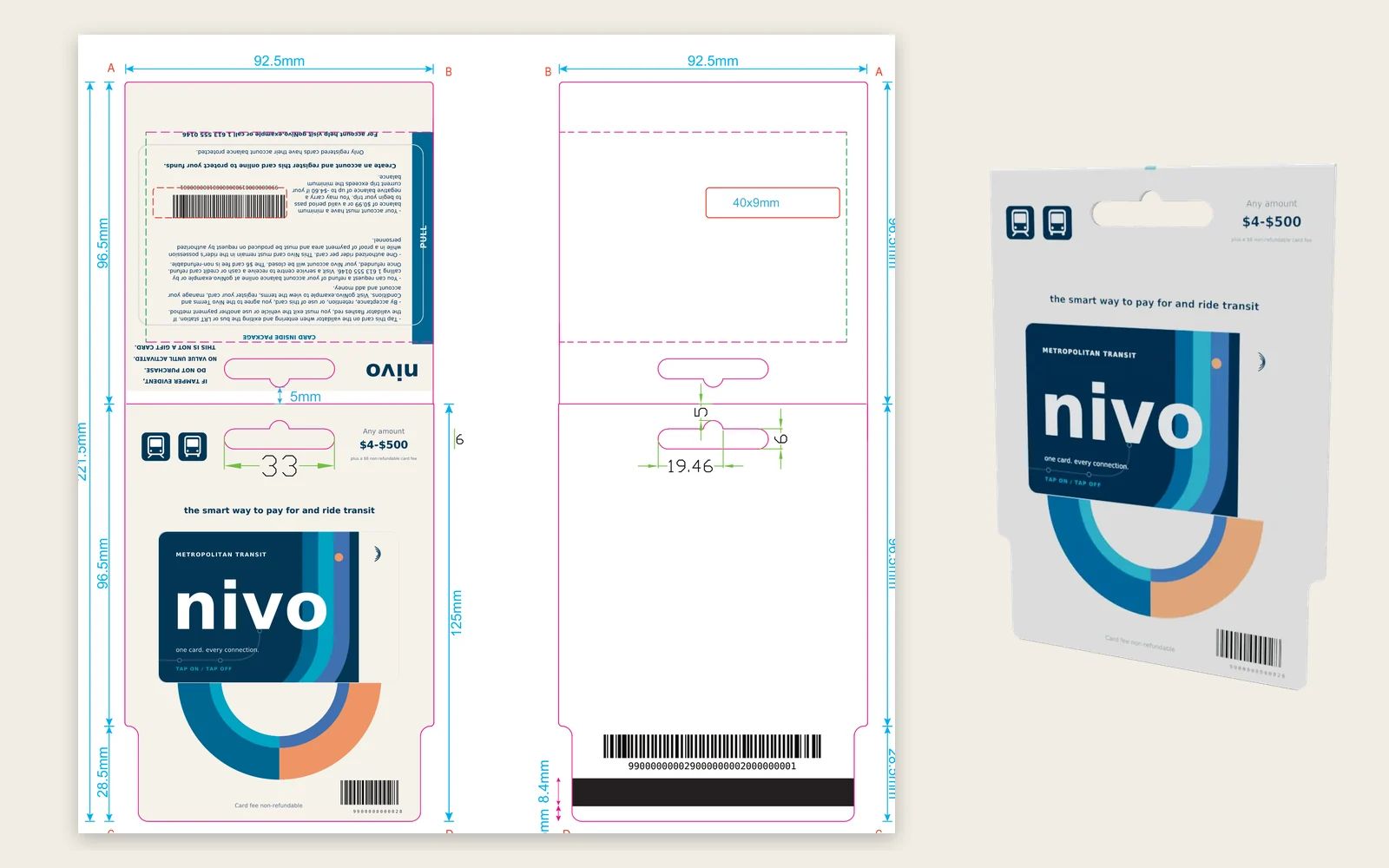
- Panels that fold behind are printed upside down. On the flat Nivo sheet the upper panel’s text is upside down; folded, it reads the right way on the back of the pack.
- Holes through two panels are drawn twice, the same distance either side of the fold, so they line up when folded. The hang slots on the three retail packs on the demo page run from 28.5 to 33 mm wide.
- A panel that folds inside another is slightly narrower, commonly about 1.5 mm (1/16 in), more on thick board, so the carrier closes flat.
- Glue areas stay bare of ink, varnish, foil and laminate unless the factory says otherwise.
- Keep text 3 mm from folds, cuts and perforations, and run backgrounds past the die line. A pull strip can carry one word of its own: the Nivo strip says PULL.
- Leave room for variable data. The Northvane pack’s serial number is inkjet printed on the inside panel in 14 pt type.
| Carrier | Stock | Size | Holds | Opens by |
|---|---|---|---|---|
| Aurevane | 250 gsm paper, gold hotfoil both sides | 69.2 × 62.3 mm folded | A 50.8 mm bamboo RFID chip | A pocket in a four-panel fold |
| Nivo | 350 gsm card, matt varnish | 92.5 × 125 mm | A CR80 PVC card | Pull strip; 40 × 9 mm window |
| Northvane | 350 gsm art board, matt varnish | 110 × 127 mm folded, 254 × 110 mm flat | A CR80 PVC chip card | Perforated back panel peels open |
| Zuno | 300 gsm art card | 175 × 250 mm sheet | A 2FF punch-out SIM card | Two perforations, peel panel |
| Ventoro sleeve | 250 gsm coated paper | 60 × 89 mm | A CR80 PVC key card | The card slides in and out |
For the sleeve and the key card in it, see hotel key card design.
What shows through a carrier window?
Only the part of the card directly behind the window, so card artwork and carrier artwork are designed as one picture. A window that frames an account number or a logo needs that detail in the same place on every card in the run, with a margin around it, because a card glued by machine can land slightly off its mark; ask the factory for its placement tolerance. Check the window on the carrier proof, the detail on the card proof and the card position on the dieline, then look at all three folded together: a flat sheet shows the window and the card side by side, never one behind the other.
How do you check a carrier in 3D before it is printed?
Open the carriers on the demo page and use their buttons: Insert chip, Pull strip, Peel it open, See inside to look through the paper at the card’s position, and Open flat to check every panel is the right way up. Each was built automatically from its proof sheet.
For your own job, upload the factory proof sheet you already make, with its dieline, and Proofscene folds it into an interactive 3D carrier to send your customer on a branded link; drop the card’s proof sheet in with it and the real card goes inside, where the carrier’s proof puts it. A carrier works straight from its factory proof sheet, exactly as it is. Create a free account: 5 free 3D proofs to start, and more every month.
A 3D proof settles the look, the fold and the card’s position in one link the customer opens anywhere.
Related reading
See proof-sheet software for card manufacturers, packaging proofing and 3D packaging mockups: from dieline to proof.
Card carrier design, answered
Short answers on carrier formats, sizes, matching and templates.
Ask us anythingWhat is a card carrier?
The printed paper or board piece a plastic card travels on or in: the letter a new credit card is mailed on, the hanging pack a gift card is sold in, the starter pack around a SIM card, or the sleeve a hotel key is handed over in. It holds the card in a set place, carries the instructions and the brand, and often shows part of the card through a window.
What size is a credit card carrier?
The card is CR80, 85.60 × 53.98 mm. A mailed credit card carrier is usually a letter or A4 sheet folded to fit a window envelope; retail packs vary with the design, such as the 110 × 127 mm Northvane rewards pack on the Proofscene demo page. Take the exact size from the converting factory’s dieline.
What is a match-and-attach carrier?
A carrier printed with one customer’s data, onto which that customer’s own card is attached, so the name, number or barcode on the carrier must match the card. On the Nivo transit pack on the demo page, the card’s printed account number lines up in a 40 × 9 mm window, and the carrier has its own barcode and stripe encoded from the card’s data.
Is there a card carrier template?
Carrier dielines come from the factory that converts them, because glue, window and card position depend on its machines, so ask your supplier for theirs. To see how real carrier proof sheets are laid out, download the proof PDF beside each carrier on the demo page; for the card itself, use the free CR80 card template and artwork checker.
Can I see my card carrier in 3D before it is printed?
Yes. Upload the carrier’s proof-sheet PDF with its dieline to Proofscene and it folds into an interactive 3D carrier: pull strips and peel-open panels work, and the card sits inside.