Hotel key card design: size, template, finishes and sleeve
A hotel key card is a standard CR80 card, 85.60 × 53.98 mm with 3.18 mm corners and 0.76 mm thick, printed edge to edge on both faces. Design it at 91.60 × 59.98 mm with 3 mm bleed, keep text 3 mm inside the edge, and then design around what the lock reads: a magnetic stripe along the back, or an RFID chip and antenna sealed inside the card.
This guide covers the design: size and template, the artwork rules for each kind of key, finishes, wood keys and the sleeve. Getting the finished artwork approved by the hotel is a separate step, covered in the hotel key card artwork approval checklist.
What size is a hotel key card?
Hotel key cards use the ISO/IEC 7810 ID-1 size of a bank card, so card printers, encoders and templates made for CR80 fit them.
| Measure | Value |
|---|---|
| Finished size | 85.60 × 53.98 mm (3.370 × 2.125 in) |
| Thickness | 0.76 mm (30 mil); ISO allows 0.68 to 0.84 mm |
| Corner radius | 3.18 mm |
| Artwork with 3 mm bleed | 91.60 × 59.98 mm, 1082 × 708 px at 300 dpi |
| Safe area for text | 3 mm inside the trim: 79.60 × 47.98 mm |
| Wood key card | Thicker than PVC: the Alder House cherry demo card is 1.8 mm |
| Key card sleeve | The Ventoro demo sleeve is 60 × 89 mm, 250 gsm coated paper |
For a true-size hotel key card template, open the free CR80 card template and artwork checker and choose Hotel key card: trim, bleed, safe area and antenna zone, a 2-track or 3-track stripe when you need one, and a layered PSD, SVG, PDF or PNG to download. Printer canvases and pixel sizes are in CR80 card size.
Magstripe or RFID: how does the lock change the artwork?
The lock decides what the back of the card must leave clear. A magstripe key gives a band along the top of the back to the stripe, and nothing raised may sit near it. An RFID key shows nothing on its surface, so both faces print edge to edge, but metal finishes should stay off the antenna inside.
| Rule | Magstripe key | RFID key |
|---|---|---|
| What the lock reads | A stripe along the top of the back | A chip and antenna sealed inside |
| Space it takes | A 12.70 mm tape (3 tracks) or 8.40 mm (2 tracks), its top about 4.5 mm below the edge, end to end | None you can see |
| Keep clear | Text 2 mm from the stripe; nothing raised from 2.54 to 19.05 mm below the top edge | Foil and metallic ink over the antenna ring, unless the card maker approves |
| Printing on it | Leave the tape unprinted unless the factory offers a colored stripe | Print anywhere |
| Lamination | On matte or frosted keys, ask for a smooth zone under the stripe | Any finish |
| Stripe type | LoCo (usually brown) suits keys rewritten every stay; HiCo (usually black) resists accidental erasure. Ask which the encoders write | Not applicable |
On a contactless card built to ISO/IEC 14443-1 Class 1, the antenna coil runs in a ring between a centered 81 × 49 mm rectangle and a 64 × 34 mm one: about 2.30 to 10.80 mm in from the short edges and 2.49 to 9.99 mm in from the long edges. A foil logo in the middle of the card sits clear of that ring; a foil border sits on top of it. Ask the card maker for its rule and test samples on the hotel’s locks, as does foil interfere with NFC and RFID cards? explains.
A key can carry both: the Ventoro canyon key card on the demo page has an RFID chip inside and a HiCo stripe and barcode on the back. Stripe tracks and tolerances are in magnetic stripe dimensions.
What goes on the front and back of a hotel key card?
- Front: the property’s name and logo, full bleed, plus an arrow on a magstripe key showing which way it goes into the lock.
- Back: short guest copy such as the Wi-Fi network, the phone number and a return note, below the stripe on a magstripe key.
- Variable data: a room number or serial printed card by card, by thermal ribbon or inkjet, as on the Ventoro card’s thermal room number. Hotels that keep the room number off the card write it on the sleeve.
- A group of properties: one design with the name and phone number changed per property; check every version against the right property.
Which finishes suit a hotel key card?
Semi-matte or matte lamination is the usual choice, frosted on keys without a stripe, with one accent such as a gold or silver foil logo or raised spot UV. Matte keeps a logo readable under lobby lights; gloss gives photographs the deepest color, as on the Ventoro card, which the demo lets you switch to matte or frosted. Gloss vs matte vs frosted cards compares all nine laminations. Keep foil in the middle of an RFID key, and raised UV on the front or below 19.05 mm on the back of a magstripe key. File setup for each finish is in the print embellishment guide.
How are wood key cards designed?
A wood key card is designed for laser engraving: the artwork is a solid vector shape the laser cuts into the grain, where it reads darker than the wood around it. The chip and antenna are sealed inside. The Alder House cherry wood key card on the demo page is 1.8 mm cherry, engraved on both faces; X-ray it to see the chip in its cavity.
- Choose the wood with the logo on it. The same mark reads differently in cherry, black walnut, sapele, bamboo, maple, birch or beech, the seven woods Proofscene renders.
- Keep strokes bold. Hairlines and small serif type burn unevenly as the grain changes; test the smallest text on the chosen wood.
- Say which face is engraved and which is printed, because a wood card can carry both.
Each card carries its own grain, which is part of the appeal; see the wooden card engraving proof guide.
How do you design a key card sleeve?
A key card sleeve, also called a holder or jacket, is a folded paper pocket printed to match the card, a few millimeters larger than it, with a thumb notch so the guest can pull the card out. The Ventoro sleeve is 60 × 89 mm for a card of 53.98 × 85.60 mm standing upright, about 6 mm wider than the card, folded from the die on its proof sheet.
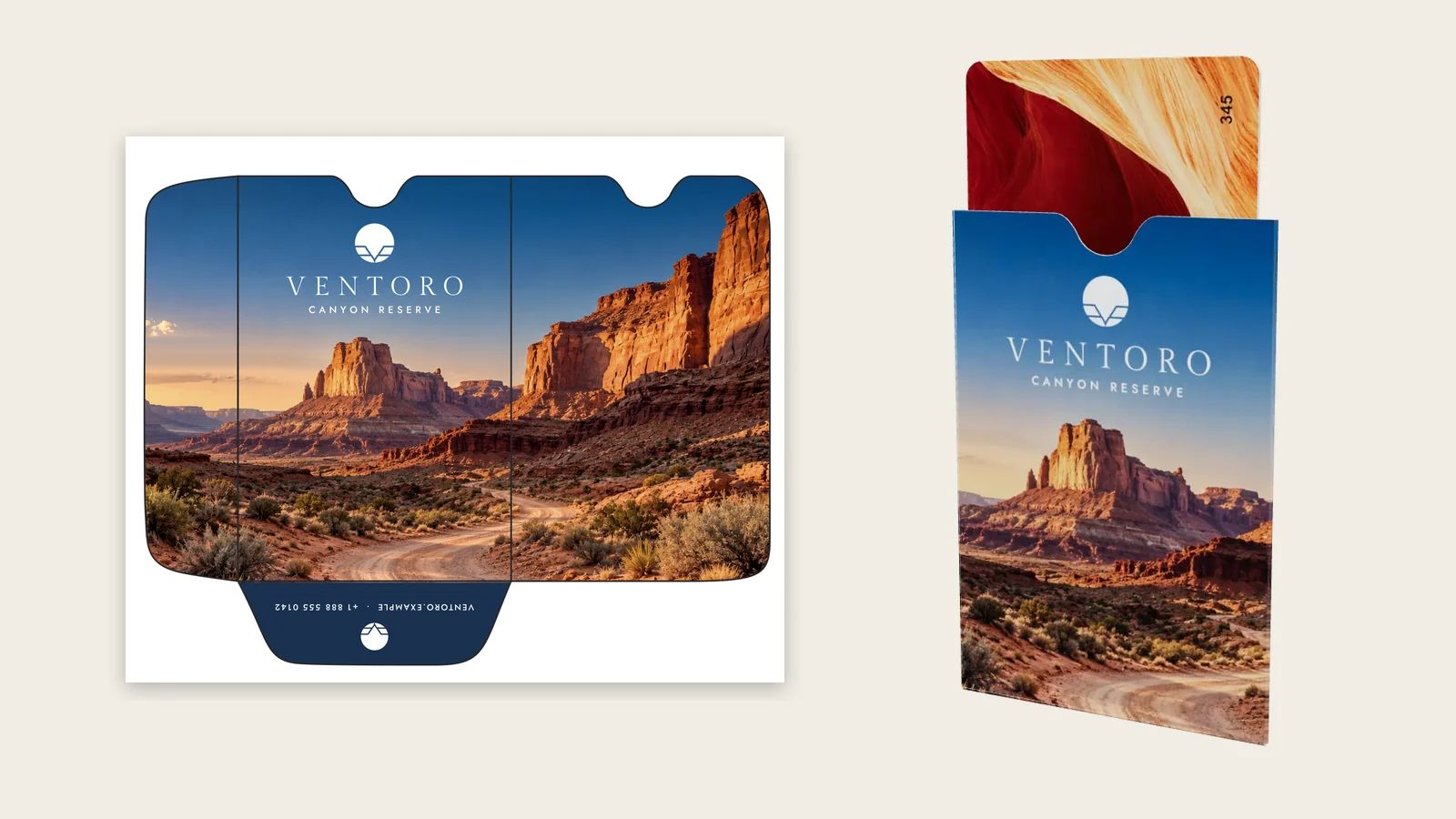
- Panels the right way up when folded: a flap that folds over is printed upside down on the flat die, like the navy flap with the phone number.
- Keep text 3 mm from folds, cuts and the notch, and run backgrounds past the die line.
- Give the back a job: a room-number box, the Wi-Fi details and the phone number, so the card’s own back stays clean.
Open the Ventoro key sleeve and card to slide the card in and out, see through the paper, or open the sleeve flat.
How do you see a key card and sleeve in 3D before ordering?
Put your design on a true-size card in the free 3D card mockup generator to compare laminations, foil, spot UV and a stripe under moving light. For the whole job, Proofscene turns the card’s and the sleeve’s proof-sheet PDFs into interactive 3D proofs, with an X-ray of the antenna and chip, that the supplier sends the hotel on a branded link. Create a free account: 5 free 3D proofs to start, and more every month. For a key card maker’s own workflow, read how PrintPlast proofs hotel key cards and wristbands in 3D.
Related reading
See card carrier design, magnetic stripe dimensions and, for resorts that use bands instead of cards, the Velmara room key wristband in 3D.
Hotel key card design, answered
Short answers on size, templates, RFID, wood and sleeves.
Ask us anythingWhat size is a hotel key card?
A CR80 card: 85.60 × 53.98 mm (3.370 × 2.125 in), 0.76 mm thick, with 3.18 mm corners. Design the artwork at 91.60 × 59.98 mm, which adds 3 mm of bleed on every side, and keep text 3 mm inside the trim.
Is there a free hotel key card template?
Yes. In the free CR80 card template and artwork checker, choose Hotel key card: it draws the trim, bleed, safe area and antenna zone at true size, adds a magnetic stripe when you switch one on, and downloads a layered PSD, an SVG, a PDF or a PNG. Drop your own front and back in to check them.
Can an RFID hotel key card have foil?
Yes, with the foil placed clear of the antenna ring near the card edge: a foil logo in the middle of the card is the classic choice. Ask the card maker for its rule and test finished samples on the hotel’s locks before the full run.
Can a hotel key card be made of wood?
Yes. A wood key card has the chip and antenna sealed inside and is usually laser engraved, so the logo is cut into the grain. Each wood reads differently, so choose the species from a sample; the 3D proof shows the hotel exactly which wood and engraving it is choosing.
What goes on a key card sleeve?
The hotel’s brand on the front, and on the back what the card has no room for: a room-number box, the Wi-Fi network, the phone number or a welcome message. The sleeve is printed to match the card, a few millimeters larger, with a thumb notch to grip the card.