See InsideWater and heatingUpdated
How does a centrifugal pump work?
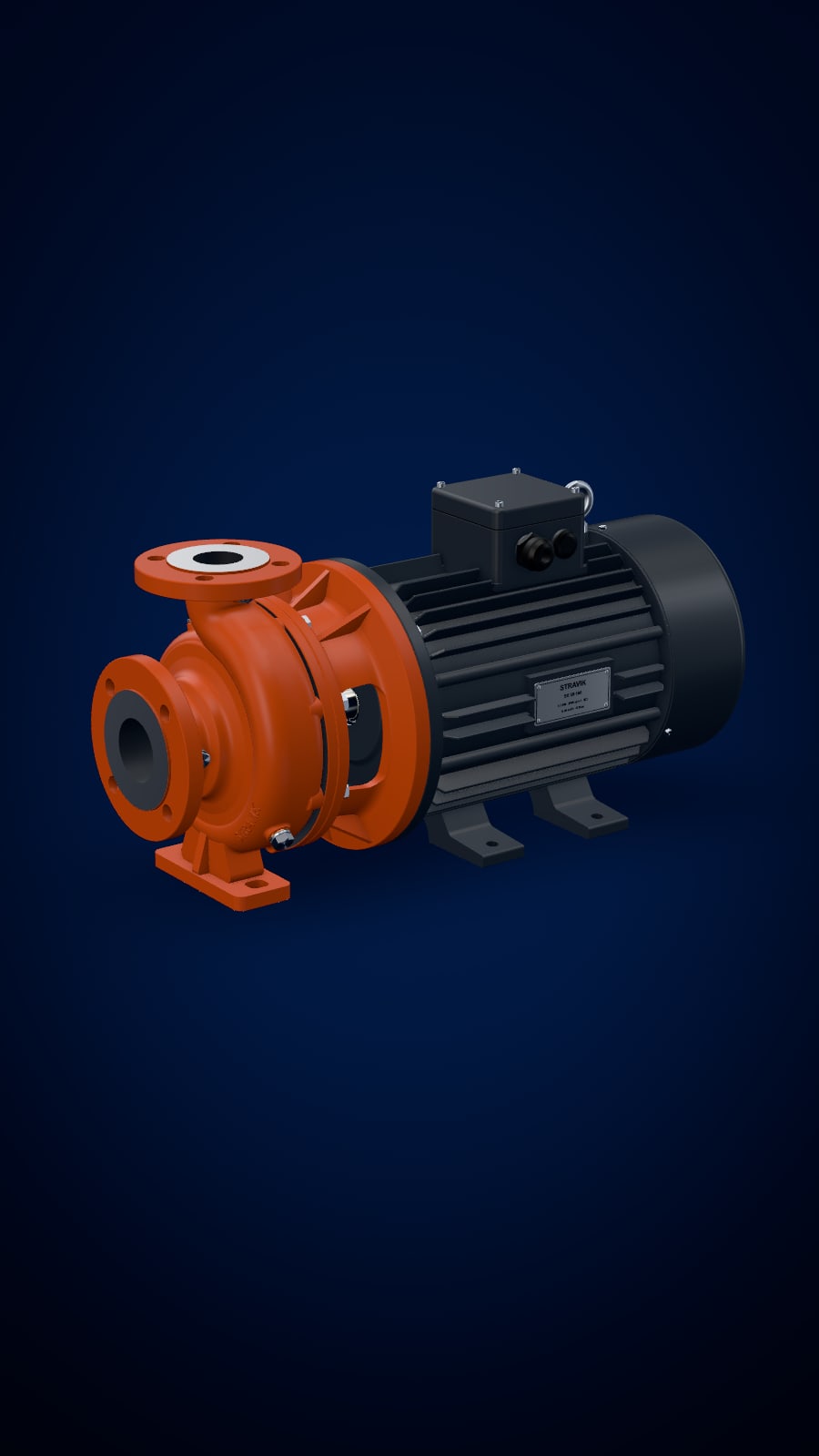
A centrifugal pump works by spinning. An electric motor turns an impeller, a wheel of curved vanes, about 2,900 times a minute in this pump. Water enters at the center of the impeller, the vanes fling it outward, and the spiral casing around it, called the volute, slows the water down and turns its speed into pressure. X-ray the pump above and watch the water run through it.
How it works, step by step
Follow the centrifugal pump from the outside in. Each step is something you can see happen in the 3D view above.
Power in
The electric motor is the larger half of the pump. Its rotor and the impeller sit on one steel shaft, so they always turn together.
Water in at the eye
Water arrives through the round opening at the front and flows straight into the center of the impeller, called the eye. The pump is filled with water before it starts, because spinning vanes move water, not air.
Flung outward
Six curved vanes catch the water and throw it from the center to the rim, far faster than it arrived. That outward throw gives the pump its name.
Speed becomes pressure
The casing wraps around the impeller in a widening spiral, the volute. As the channel widens the water slows, and its speed turns into the pressure that drives it up the outlet.
Kept dry
Where the shaft leaves the water, a mechanical seal does the sealing: a carbon ring pressed against a hard, flat seat, running on a film of water as thin as one micron.
Kept cool
A fan on the far end of the shaft blows air along the fins of the motor housing. A ball bearing at each end carries the shaft.
The parts inside the centrifugal pump
- Impeller
- The spinning wheel of curved vanes that gives the water its speed.
- Volute casing
- The spiral housing that turns that speed into pressure.
- Mechanical seal
- A carbon ring on a hard seat that keeps water out of the motor.
- Shaft
- One steel shaft from the impeller to the cooling fan.
- Ball bearings
- One at each end of the motor, carrying the shaft.
- Stator and rotor
- The electric motor: copper windings around a spinning cage.
- Cooling fan
- Blows air along the finned motor housing.
- Terminal box
- Where the power cable connects to the motor windings.
Centrifugal pump questions
Straight answers about the centrifugal pump and what happens inside it.
See inside more productsHow does a centrifugal pump work?
A motor spins an impeller inside a spiral casing. Water enters at the center of the impeller, the curved vanes throw it outward at speed, and the widening casing, the volute, turns that speed into pressure.
What does the impeller do?
The impeller is the spinning wheel of vanes that gives the water its energy. Water flows into its center, called the eye, and is thrown off its rim much faster than it came in.
What is the volute in a pump?
The volute is the snail-shaped casing around the impeller. Its channel gets wider all the way round, so the fast water slows down and its speed becomes pressure at the outlet.
Why does a centrifugal pump need priming?
Priming means filling the pump with liquid before it starts. Spinning vanes move liquid well and air poorly, so a standard centrifugal pump with air in its casing cannot pump. Self-priming pumps keep liquid in the casing and use it to clear air out of the suction line by themselves.
How does a self-priming centrifugal pump work?
A self-priming centrifugal pump with a separation chamber clears the air out of its own suction pipe, using liquid that stays in its casing when it stops. As it runs, the impeller throws that liquid, mixed with air from the pipe, into the chamber, where the air leaves through the outlet and the liquid drops back to the impeller. This keeps drawing the air out of the suction pipe, so the pump primes itself.
Where are centrifugal pumps used?
Almost everywhere liquid moves: water supply, sewage, farming, heating systems, oil and chemical plants, and small pumps in homes. Centrifugal pumps are one of the most common machines in industry.
What keeps the water out of the motor?
A mechanical seal. A carbon ring that turns with the shaft runs against a hard stationary seat, sealed by a film of water only microns thick.
What is cavitation in a pump?
Cavitation is when the pressure at a centrifugal pump’s inlet drops so low that the water turns to vapor bubbles at the eye of the impeller. It starts when too little water reaches the pump. When the bubbles reach higher pressure they collapse, sending out shock waves that make noise, shake the pump and wear away the impeller.
Can a centrifugal pump run dry?
No. Without water a centrifugal pump runs into cavitation and soon fails, and its mechanical seal loses the film of water that cools and lubricates its faces. That is why the pump is filled with water before it starts.
What drives a centrifugal pump?
A centrifugal pump is most often driven by an electric motor, the most common of its many possible drivers. Engines drive pumps too. In the pump on this page, the motor’s rotor and the impeller sit on one steel shaft, so they always turn together at the same speed.
How does a multistage centrifugal pump work?
A multistage pump has two or more impellers, on one shaft or on separate ones, and at each stage the water is led to the center of the impeller and leaves at its rim. Impellers connected in series give a higher pressure at the outlet, and impellers connected in parallel give more flow. Boiler feedwater pumps are a common example.
Sources
- Centrifugal pumpsWatson-Marlow Fluid Technology Solutions
- What is a mechanical seal?AESSEAL
- How Centrifugal Pumps WorkPumps & Systems
- Back to Basics: Mechanical SealsPumps & Systems
- Centrifugal pumpWikipedia
- CavitationWikipedia
Make it yours
Put your name or your company’s logo on the pump, choose a finish and a color, and share your version with one link. Whoever opens it gets your pump in 3D and can take it apart too.
- 1Type your name, or a website and we find its logo
- 2Pick the engraving style, the finish and the color
- 3Share your link, a picture or a short video
See inside more products
iPhone 17 Pro
What’s inside an iPhone 17 Pro?See inside
AirPods Pro
How does noise cancelling work?See inside
PS5 controller
How do PS5 adaptive triggers work?See inside
Turbocharger
How does a turbo work?See inside
Mechanical watch
How does a mechanical watch work?See inside
Brass padlock
How does a lock work?See inside
AirTag
How does an AirTag work?See inside- 8 products in 3D
All of See Inside
Every product, inside and outSee them all
Made with Proofscene
This page runs on the 3D technology we use to build interactive product demos for manufacturers: built from CAD, running in any browser, on their own website.
Interactive 3D product demos